

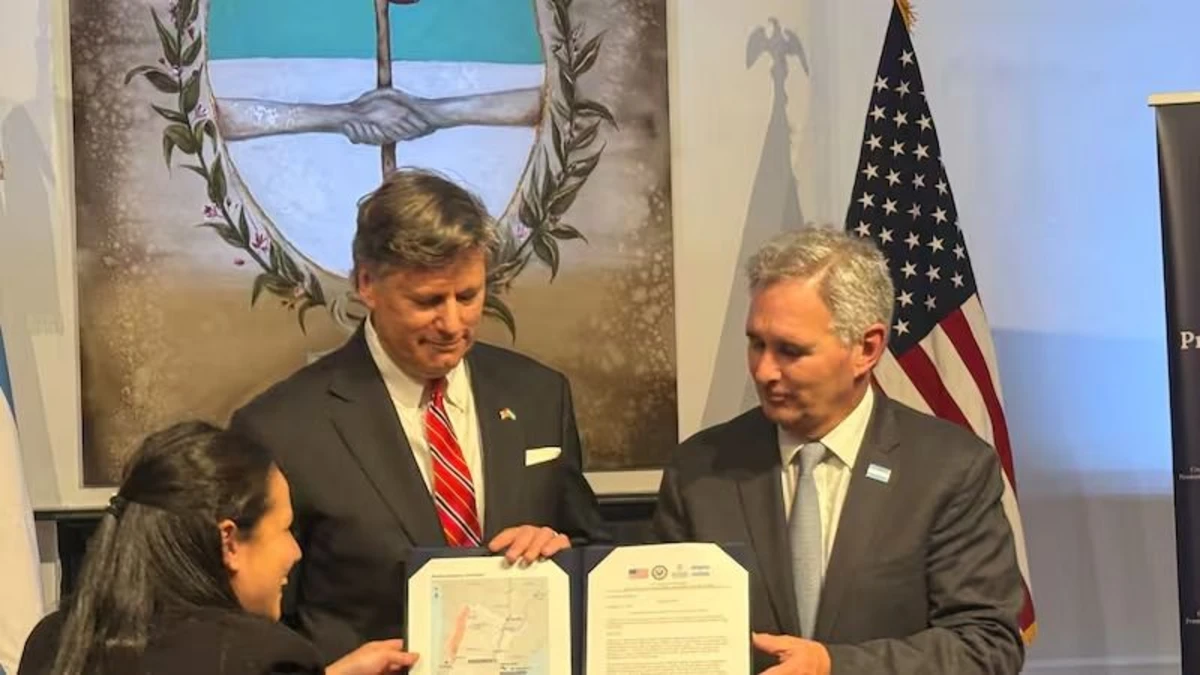
The project launch was led by U.S. Ambassador Christopher Landau and Argentine Foreign Minister Pablo Quirno.
Argentina and the United States launched the Andes-Atlantic Corridor, a joint initiative aimed at strengthening and modernizing the infrastructure connecting key economic sectors of the country with Atlantic ports and Western markets.
The launch was led by U.S. Ambassador Christopher Landau and Argentine Foreign Minister Pablo Quirno during the High-Level Week of the United Nations General Assembly.
According to a joint statement by both governments, the corridor seeks to facilitate long-term public and private investment in transport, energy, and digital infrastructure, while also promoting Argentine exports of minerals, oil, and gas.
The initiative envisions U.S. and U.S.-backed investments in railways, waterways, ports, pipelines, and infrastructure for energy generation and transmission.
Regarding transport, both countries will seek to identify priority projects to rehabilitate and expand railways, waterways, and ports, creating opportunities for U.S. companies to participate in tenders or act as subcontractors.
In the energy sector, the goal is to commercially develop Vaca Muerta’s resources through U.S. investment, technology, and financial instruments—including direct loans, guarantees, and insurance—designed to mobilize capital, equipment, and service providers.
The corridor also aims to identify opportunities linked to the Critical Minerals Framework Agreement between the two countries to support the mining and processing of these resources and to diversify global supply chains.
In the digital realm, the United States and Argentina proposed supporting the use of technology deemed trustworthy and collaborating on the security of customs inspection platforms and equipment.
Tools from U.S. agencies such as the International Development Finance Corporation (DFC), the Export-Import Bank (EXIM), and the Trade and Development Agency (USTDA)—alongside private sector resources—may be used to finance and support these projects. For its part, Argentina will seek to continue strengthening its legal and regulatory framework and investment protections to attract foreign capital, featuring transparent and predictable rules for infrastructure concessions.
The Andes-Atlantic Corridor is part of the G7 Partnership for Global Infrastructure and Investment and aligns with the U.S. strategy of supporting economic corridors deemed critical to its supply chains.
Enviar comentarios

