

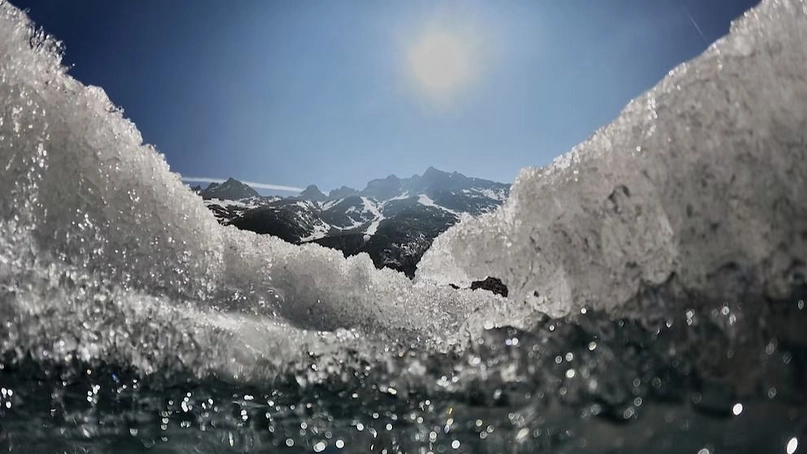
Recent research reveals that the accelerated melting of glaciers at the poles is altering Earth’s physical shape.
Although Earth’s solid surface appears firm and unchanging to the naked eye, the crust possesses elasticity that causes it to deform continuously under the influence of immense physical forces. A recent study led by geologist Christopher Kotsakis of the Aristotle University of Thessaloniki (Greece)—published in the scientific journal Journal of Geophysical Research: Solid Earth—demonstrates that this process of global deformation accelerated drastically between 1997 and 2015. Using global data collected by the Global Navigation Satellite System (GNSS) network of stations, scientists measured the vertical movements of the planet’s solid surface with millimeter precision.
Satellite records confirm that accelerated ice melt in Greenland and Antarctica is progressively lightening the load on the crust at high latitudes. As a direct consequence, polar regions are being relieved of that immense pressure and are “rebounding” upward. Between 1997 and 2000, the rate of physical uplift at the poles was recorded at just 0.5 millimeters per year; however, by 2015, that rate of vertical rise had doubled to one millimeter per year. At lower latitudes, conversely, the exact opposite is occurring.
Equatorial subsidence and the planet’s shape
Liquid water resulting from glacial melt does not remain concentrated at the poles but is redistributed across the world’s oceans. This entire mass of water flows toward lower latitudes, accumulating in the tropics and on the equatorial seabed. The weight of this excess water creates immense pressure that depresses the ocean floor near the equator—a subsidence movement accelerating at a rate comparable to the uplift at the poles.
The combination of these two simultaneous movements—rocky uplift at the poles and crustal subsidence at the equator—alters Earth’s overall shape. Historically flattened at the poles and bulging at the equator due to its rotation, the planet’s solid mass is becoming progressively less flattened and physically more spherical.
Enviar comentarios

